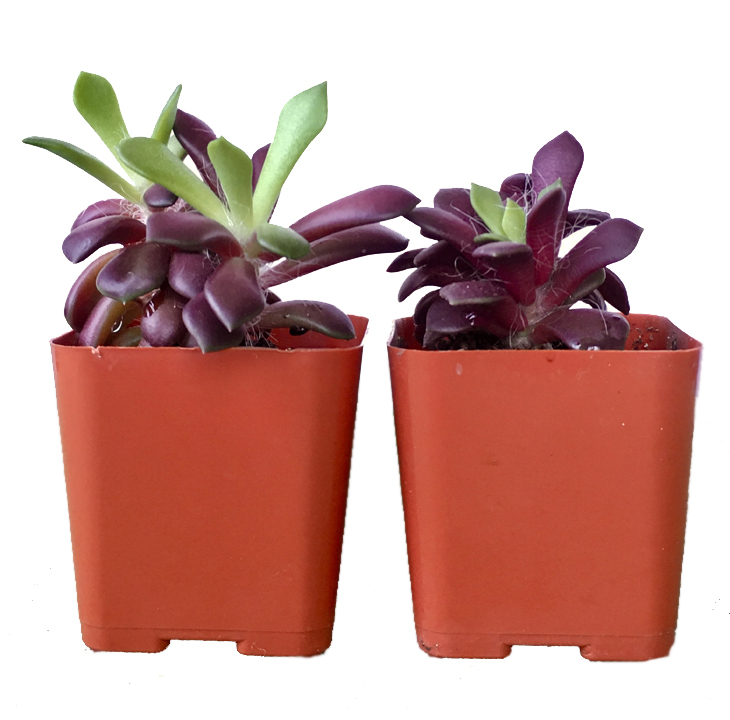
Sand Rose (Anacampseros rufescens) is one of many species of succulents native to South Africa, Ethiopia and Latin America. The botanical name Anacampseros is an ancient one for herbs supposed to restore lost love.
New Leaves are green, maturing to a deep wine-red if given ample sunlight. Grow lights held 14″-18″ seems to be enough light for sand rose, provided it’s consistently available 8-10 hours a day.
- Bright Direct Light 6 hours or longer
- Water sparsely every 10-14 days, let dry between watering
- Feed once a month May – September
- Temperature 50°F – 90°F (10°C – 32°C)
- Change soil once a year (ideally) or no longer than two, use soil that drains easily
Bright Direct Light
Sand Rose prefers abundant, bright direct light for at least 6 hours. Weaker or shorter hours of direct sunshine will result in leaves that remain green or not as deeply red as they could be. Also, you’ll get longer stems that stretch out and make the leaves less compact.
Unlike some of the other succulents at miniviridi whose leaves might bleach to a lighter color when the sun is too strong (like Burro’s Tail) or burn (like Rainbow Elephant Bush), the Sand Rose will soak up the light and turn a darker and richer purple-red. Of course if you have a blistering summer sun, watch your plant for signs of scorching…but this one seems to have a higher tolerance and shrug it all off. But watch! Your plant will always tell you what it wants. It’s a matter of learning to recognize the signs.
In latitudes where the sun is weaker (like Seattle), a south or west facing window is good all year long—except for the odd summers where the temperature stays above 90 degrees for days in a row. Again, pull it further away from the window or relocate the plant to a temporary eastern exposure if you spot any scorching. Using LED Grow Lights throughout darker months really helps keep this plant nice and compact and red as Merlot.
While there are loads of great LED plant lights on the market, this one has been the preferred brand at miniviridi, the SANSI Full Spectrum LED Grow Light 24W Bulb (300 Watt Equivalent), installed in an inexpensive swing arm desk lamp. Held at a 14″ – 18″ distance, this light works great for succulents and a good many other light hungry cacti.
Water
Sand Rose is VERY drought tolerant, and like most succulents, prefers to dry out between watering…perhaps only watering every 10-14 days for ordinary, larger plantings. However, even the tiniest plantings with this species can handle totally dry soil for weeks at a time. The leaves will look shrunken and wrinkled, the skin dull and lifeless. If it’s truly overly dehydrated, the leaves will go beyond looking a touch wrinkly, shriveling up like a tube of toothpaste whose contents were totally squeezed out. With a single watering, it’ll recover in a day or two, though you may loose some of the lower leaves if you let it go realllly dry for too long. Some lower leaf loss is normal for any plant, of course…we just don’t want it to be excessive.
For small plantings like we have at miniviridi, Sand Rose remains small with sparse watering. Stay on the side of too little water, Sand Rose is adapted for this. We recommend watering only once every 7-14 days in warmer Summer months and every 14-25 days in winter months when it’s dormant. It’s ok (even desirable) to let the leaves shrink a little, wrinkle some, before watering. Just a little.
Regardless of the size of your planting, Sand Rose doesn’t want soggy soil or to be left standing in water. Because the soil is allowed to dry completely between watering, it often becomes so dry that it repels water and never fully hydrates when pouring water from overhead (if you’re planting in a pot with drainage holes). We prefer to soak the pots in a bowl of water (half as deep as the pot) for 15-20 mintes, then drain 30 minutes on a towel to thoroughly drain. You won’t have to water as often this way, and are assured the entire root zone is hydrated. If the soil feels soggy after 30 minutes of draining, you may need to get a more fast draining soil (or just add more perlite and a some grit (sand that’s not too fine).
Our tiny plantings at miniviridi are so small that most soils dry out in time for Sand Rose to avoid root rot and other problems from excessive water…but this plant is the easiest of all our succulents to harm by overwatering.
 miniviridi.com