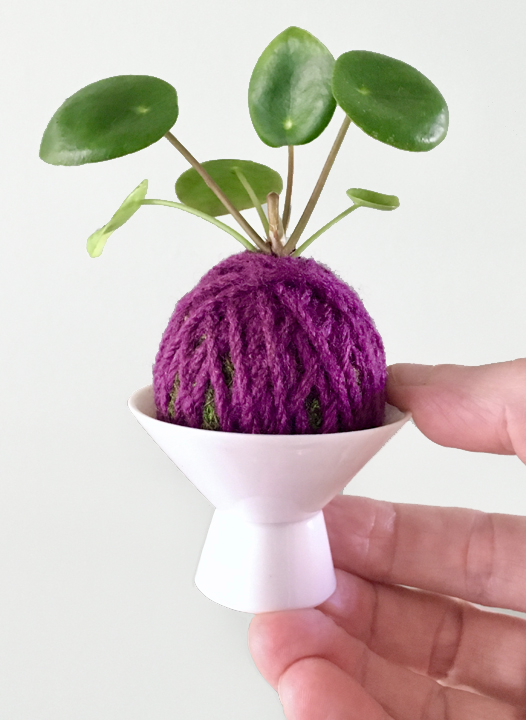
Native to southern China, Pilea Peperomioides goes by common names like Chinese money plant, pancake plant, friendship plant—there’s plenty more. Pilea is generally hardy and fairly easy to grow provided it’s not overwatered and given plenty of bright, indirect light…not direct light, however, which makes the leaves distort.
Pilea adapts well into miniaturization, including small kokedama and tiny pots, though it likely won’t reproduce by sending out little “pups” from under the soil as it does profusely when grown in larger pots.
- Bright Indirect Light 6 hours or longer
- Water every 7-10 days, let partially dry between watering
- Use well-draining soil
- Feed lightly once a month May-August
- Temperature 50°F – 90°F (10°C – 32°C)
- Change soil once a year (ideally) but will tolerate two years
Bright Indirect Light
Bright indirect light would be NEAR a south or west facing window, provided it’s not scorching hot (this’ll depend what latitude you live at and the season). If your window has a sheer curtain drawn to diffuse direct sunlight Spring through Summer, you could move the plant even closer. Light that’s too direct can distort the leaves from smooth and saucer shaped into twisted, lumpy and uneven shapes.
Pilea is adaptable, though, and some find that theirs do fine right on the windowsill looking south all day long. East windows are acceptable Spring-Summer and might be enough light for some lower latitude dwellers Autumn-Winter. North windows aren’t ideal, but Pilea will survive by getting longer, leggy and lanky. Grow lights work well for these too, though if you see distorted leaves, move the lights further away or lower the brightness level if it’s adjustable.

Which way do I go? For northern climates where the sun is weak or overcast from late Autumn through early Spring, the stems on its leaves can start to twist at odd angles, searching for light that’s too low or diffused. Often the plant will go semi-dormant at this stage and it’s best to cut back on watering to once every two weeks or only when the leaves start to show signs of drooping.
Watering too much during semi-dormancy will easily cause lower leaves to yellow and drop off, though it’ll usually pull through once brighter seasons arrive or a grow light is used. The twisted stems will also unfold and resume their normal appearance once mid-Spring light levels resume—the addition of light fertilizer at this time helps wake it up too.
The SANSI Full Spectrum LED Grow Light (24W Bulb) we ordinarily use for our succulents and other plants that require high amounts of light is far too strong for Pilea, unless you move the light at least three or four feet away. You could also simply use a lower wattage grow light, the weakest work very well for Pilea.
Water
Pilea generally prefer to dry out some between watering…perhaps every 7 days during sunny and warm seasons. For ordinary plantings in 6″-10″ pots, dig your finger 2 inches down into the soil and see if it feels dry. For small plantings like we have at miniviridi, once a week may still be appropriate, but as the smaller amount of soil will dry out faster, increase to twice a week if your Pilea gets droopy.
Pilea leaves naturally droop a little, though droop is really too strong a word. Long thin stems that end in a big green umbrella will have a nice downward sloping bend…elegant. Stems that hang down like tired arms struggling with shopping bags–that’s definitely a sign it’s past time to water. It’ll likely recover, though, Pilea are tolerant of a little drought.
If your Pilea is growing in a kokedama, you’ll feel the soil ball is very lightweight when it’s time to water. Pour 2-4 tablespoons of water into the kokedama’s dish (depending of you kokedama’s size) and let it soak up all the water, which should happen in a few minutes. If you prefer to fully submerge and soak your kokedama in a separate bowl, be sure to drain off excess water, letting it rest on a towel for 30 minutes. If you’re loosing too many leaves a few days after watering, you may be overwatering…but loosing a few leaves occasionally is reasonable.
Cooler/darker seasons, you’ll want to cut back on watering unless you’re using a grow light and seeing active growth. During these semi-dormant months, watering every 10-14 days is appropriate. Again, loosing an occasional lower leaf to yellowing after a watering isn’t a cause for alarm. If more than a few leaves are yellowing or growing pale…lighten up on the H2O. Pilea can handle dryness far, far better than soggy soil or too much water when it’s half-asleep in winter.
Feeding
For small and miniaturized plantings where you don’t want to encourage overgrowth, feeding with a low nitrogen fertilizer once a month during growing season is ideal—May through September. Winter in all climates is a good time for plants to rest, holding off with the feedings until spring. If you have a Pilea planted in a regular sized pot and no intention to keep it small, by all means, use a higher nitrogen plant food.
A liquid fertilizer is easiest to use for small plantings, one drop into 8 ounces of water is enough if you only need to make a small batch of fertilizer water. These plants are native to areas with poor soil, making sparse feeding appropriate.
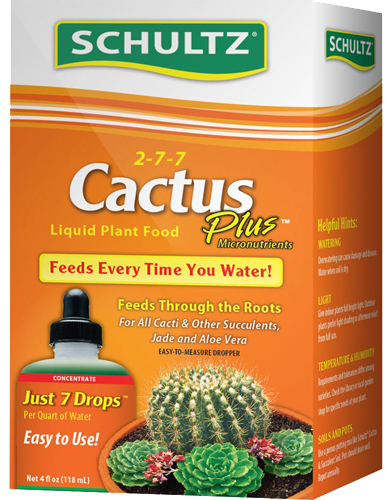
Liquid fertilizers are nice in that they come with a dropper, making it easy to measure out small amounts. 1 drop/8oz. of water.
Use a Cactus/Succulent fertilizer (2-7-7) if you really plan to keep your plants on the side of small and slow-growing.
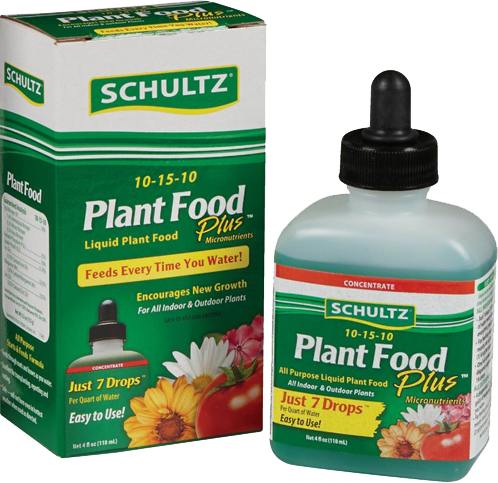
With general purpose liquid fertilizer (10-15-10…higher nitrogen, phosphorus, and potassium), the higher nitrogen levels might stimulate overgrowth in your miniaturized plant, making it grow spindly and loose its compact shape. However, used very lightly, micro-dosed, it may be passable.

With these organic liquid fertilizers, the lower nutrient level honestly means you could fertilize with either (2-2-2 for Organic Indoor! and 1-2-2 for Organic Cactus!) as they’re both low nitrogen.
1/4 teaspoon/8oz. of water would be your mixture ratio for these. Somewhat smelly, but effective.

Temperature
55°F – 75°F is optimal, but can tolerate 40°F – 90°F for short periods. Below 50°F for extended periods risks cold damage, avoid leaving too close to the window during freezing outdoor temperatures. An inexpensive indoor thermometer will tell you what the micro-climate is like on your windowsills, if you’re so inclined. There can be up to 10° difference from the rest of the room, but generally you’ll want to pull plants a couple feet away from the window during very hot and very cold weather unless you’re sure. Pilea are astonishingly cold hardy in the wild and grown outdoors, however the plant will die back and have to regrow from below ground.
Trimming and Cultivation
Pilea reproduce by growing little “pups” from its roots, pushing up through the soil and sometimes even through drainage holes in the bottom of your pot. You can also cultivate new plants through cuttings. If a Pilea gets too tall or leggy, spindly, you can cut a section from the main trunk and place it in water until roots appear, then plant. Even planting the cutting directly into moist soil will usually result in roots growing successfully.
With Pilea grown in kokedama, if the main trunk gets too tall, it’s probably time to unwind the ball and replace the spent soil anyway. You can cut the top 1″-3″ and strip off the lower leaves if necessary in order to plant the trunk deep into a freshly made kokedama (depending how big a ball you want). Keep in mind that the old root ball that still has some trunk left on it will regrow new leaves eventually. You decide whether you want to have two plants (one to share, perhaps), or lay the old root ball to rest. You can always plant the old root ball in a regular pot too, and let it grow as big as it pleases! New cuttings, old root balls with a bit of stump left over, baby pups that have been clipped off and transplanted are all a little slow to show signs of new growth, but be patient. Once the roots are established and if it’s Spring-Summer (growing season), it’ll take off.
 miniviridi.com